
README file from
GithubStandardForm
A plugin for Obsidian that transforms code blocks with logical Standard Form syntax into clean, styled renderings, enhancing readability of logical reconstructions. Perfect for philosophy, logic, and formal notation.
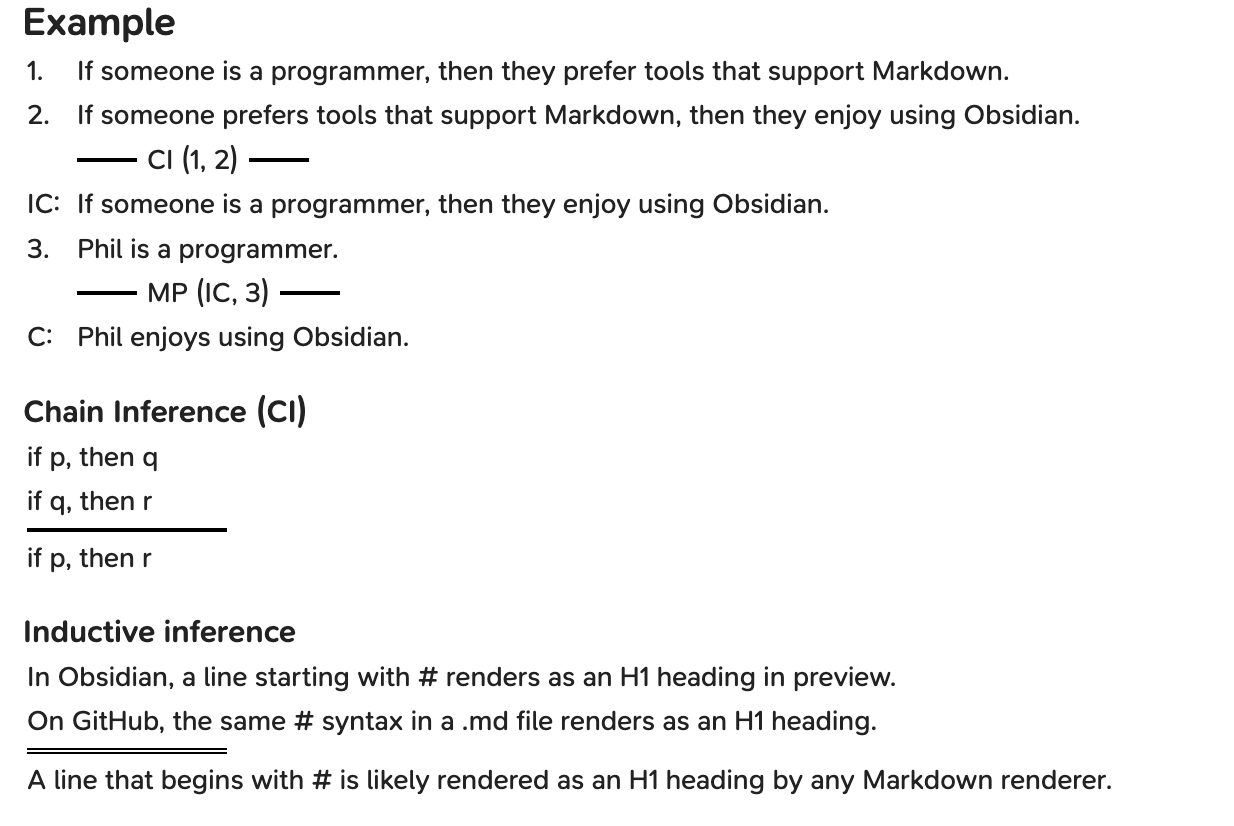
Demo
Usage
To enable parsing, code blocks have to be specified as "standardform" language.
```standardform
1. If someone is a programmer, then they prefer tools that support Markdown.
2. If someone prefers tools that support Markdown, then they enjoy using Obsidian.
 -- CI (1, 2) --
IC: If someone is a programmer, then they enjoy using Obsidian.
3. Phil is a programmer.
-- MP (IC, 3) --
C: Phil enjoys using Obsidian.
```
```standardform
if p, then q
not q
--
not p
```
Format
- Identifiers must end with either a colon (
:) or a period (.), such asP1:,C1., orSomething:.- If you want to use a colon or period in your premisse or conclusion text, it needs to be escaped with a backslash:
Some text\. More text.
- If you want to use a colon or period in your premisse or conclusion text, it needs to be escaped with a backslash:
- Identifiers can be ommited.
- Conclusion lines can be written either as
-- any text --or simply--to create a line without text.- To indicate a inductive inference,
==can be used to draw a double line (also works with== text ==)
- To indicate a inductive inference,