
README file from
GithubObsidian UltraSearch Plugin
UltraSearch is a high-performance community Obsidian plugin that lets you search and rank both file names and individual line contents across all Markdown files in your vault. It also features a powerful Gemini AI search to answer complex questions based on your vault's content.
Use Cases
If you rely on daily notes to capture thoughts, tasks, or lists without adding tags or backlinks, finding specific information later can be challenging. Standard search tools often fail to locate these details or return irrelevant results. UltraSearch solves this by indexing and searching at the individual line level, making your notes instantly and precisely searchable. For more complex queries, you can seamlessly switch to Gemini search to synthesize intelligent answers directly from your notes.
Features
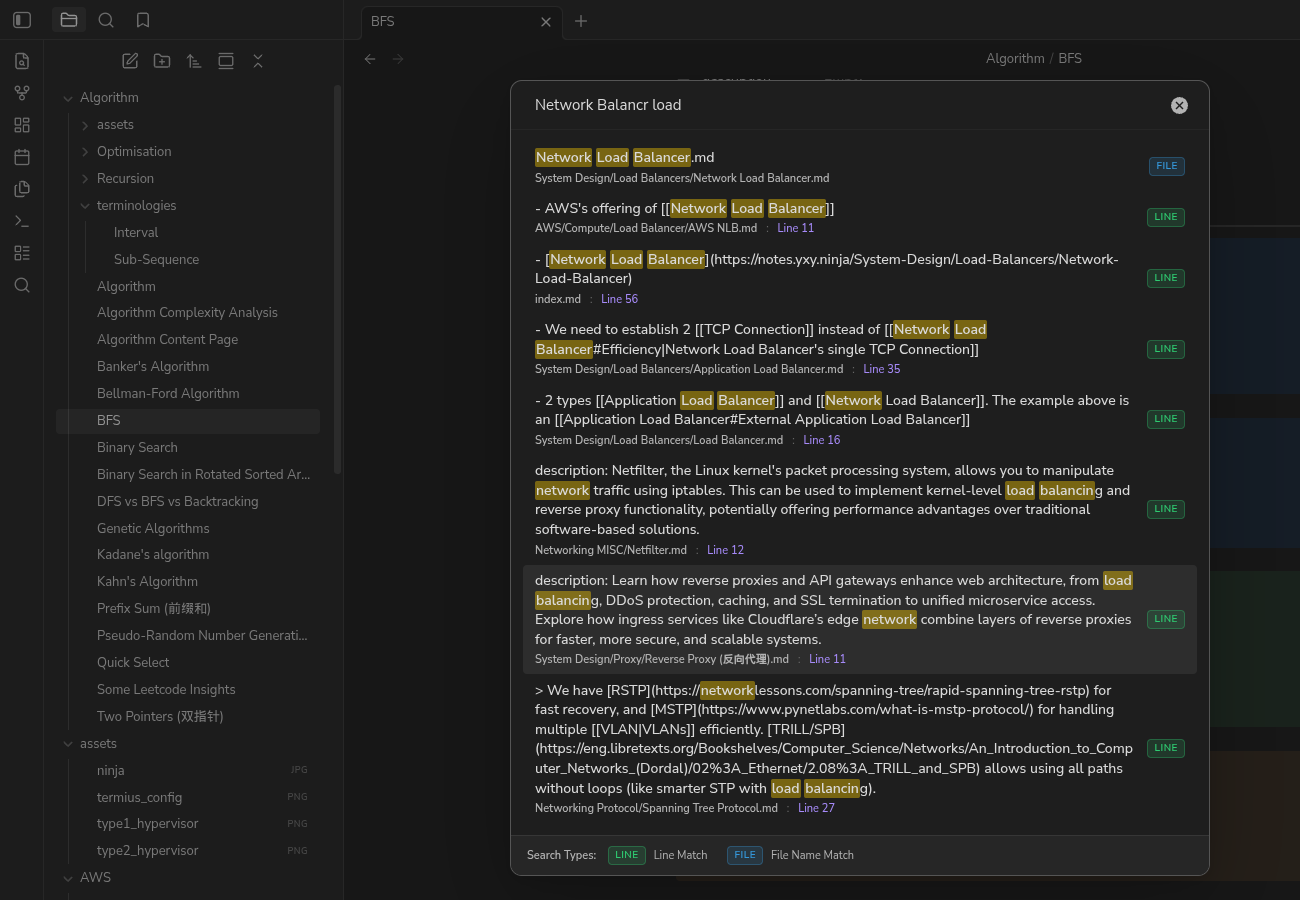
🔍 Fuzzy Search
-
Unified File Name & Line-Level Search:
- Searches every file name and every line of every Markdown file independently.
- Shows both matching file names and matching lines directly in the suggestions list.
-
Harmonious Color-Coded Badges:
- Every result is clearly categorized using HSL-tailored, theme-compatible colored badges on the right side:
- Green Badge (Line): Indicates a line search match.
- Blue Badge (File): Indicates a file name match.
- A static search type legend is fixed at the bottom of the modal window wrapper to define the colors clearly.
- Every result is clearly categorized using HSL-tailored, theme-compatible colored badges on the right side:
-
Advanced Matching & Ranking:
- Out-of-Order Multi-Word Search: Querying space-separated terms (e.g.
hello world) matches items containing all terms in any order (AND search). - Exact Substring Match: High-priority matching for exact term matches in the file name or line.
- Typo-Tolerant Word Prefix Match: For query terms of 3-5 characters, matches words with up to 1 typo; for terms of 6 or more characters, matches words with up to 2 typos.
- Order-Aware Scoring:
- Sorts results descending by relevance (best match first).
- Higher base scores for exact matches and word-boundary starts.
- Sequence order bonus (+20 score) when terms appear in the same order as the query.
- File matches receive a slight score boost (+10) to prioritize note files when match relevance is identical to content matches.
- Penalizes long file names/lines slightly (by 0.01 per character) to favor shorter, more concise matches.
- Out-of-Order Multi-Word Search: Querying space-separated terms (e.g.
-
Editor Navigation:
- Hitting
Enteror clicking on a line suggestion opens the note and scrolls directly to that line. - Hitting
Enteror clicking on a file suggestion opens the file at the top. - Support for opening files in new tabs/panes by holding the
Ctrl/Cmdmodifier key.
- Hitting
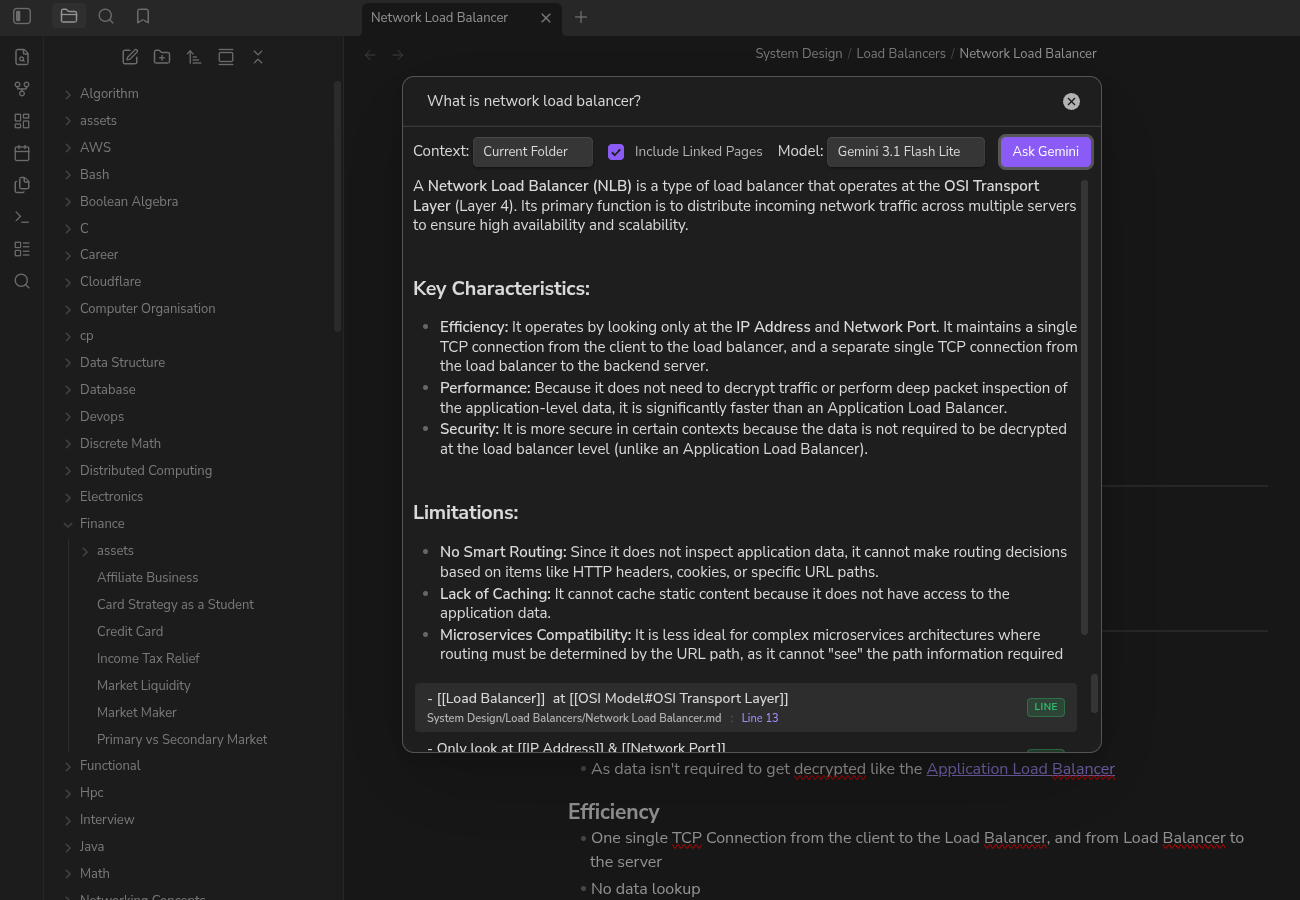
🤖 Gemini AI Search
- AI-Powered Answers:
- Press
Tabwhile the search modal is open to switch to Gemini Search mode. - Ask complex questions and Gemini will synthesize an answer based on your notes.
- Press
- Flexible Context Selection:
- Choose the context scope for the AI: Current File, Current Folder, or Entire Vault.
- Option to include linked pages in the context.
- Markdown Rendering & Citations:
- The AI's response is rendered in standard Markdown right inside the modal.
- Gemini cites its sources, which appear as clickable line or file matches below the answer, allowing you to quickly jump to the source material.
How to Use
- Open the Command Palette (
Ctrl/Cmd + P), typeUltraSearch: Open, and pressEnter. (Alternatively, click the magnifying glass ribbon icon on the left sidebar). - Fuzzy Search: Type your search terms (separated by spaces). Use the arrow keys to navigate matching files and lines.
- Gemini Search: Press
Tabto switch to Gemini mode. Configure your context and model from the toolbar, type your question, and click "Ask Gemini".
Adding your Gemini API Key
To use the Gemini AI search feature, you need to provide a Gemini API key. For security reasons, the key must be stored securely using the Obsidian keychain rather than in plaintext settings.
- Get an API Key: Obtain a free API key from Google AI Studio.
- Store the Secret: Open Keychain in Obsidian and save your API key securely under a Secret ID (e.g.,
gemini-api-key). - Configure UltraSearch:
- Go to Obsidian Settings -> UltraSearch.
- Under the "Gemini API Key Secret" setting, select the Secret ID you used in the previous step.
Settings
- Minimum query length: The minimum characters you need to type before the search starts.
- Maximum results: The maximum number of results to display in the list (defaults to
10to keep rendering fast). - Exclude folders: Comma-separated list of directories (e.g.,
templates, archive) to ignore during line indexing. - Gemini API Key Secret: Select the securely stored Secret ID containing your API key.
Security & Privacy
Vault Enumeration & Data Access
This plugin uses the Obsidian API (app.vault.getMarkdownFiles) to discover Markdown files in your vault.
- Fuzzy Search (Local-First): All indexing, scanning, and search matching run entirely on your local machine. No vault data, file paths, or search queries ever leave your device or get transmitted over the internet.
- Gemini Search: When using Gemini Search, the text contents of files within your selected context scope (File, Folder, or Vault) will be sent to the Google Gemini API to generate an answer. Be mindful of sensitive data when using the "Entire Vault" context.
License
This project is licensed under the MIT License.
Local Development & Installation
Building From Source
If you are compiling this plugin from source:
- Clone or download the repository files.
- Open a terminal in the plugin directory and run:
npm install - Compile and bundle the plugin:
This will generate anpm run buildbuild/folder containing the compiled code bundle (main.js), metadata (manifest.json), and stylesheets (styles.css).
Loading into Obsidian
- Copy the
buildfolder into your Obsidian vault's plugins folder under the nameultra-search:cp -r build <path-to-your-vault>/.obsidian/plugins/ultra-search - Open Obsidian and go to Settings -> Community plugins.
- Enable UltraSearch from the list of installed plugins.